
RSU
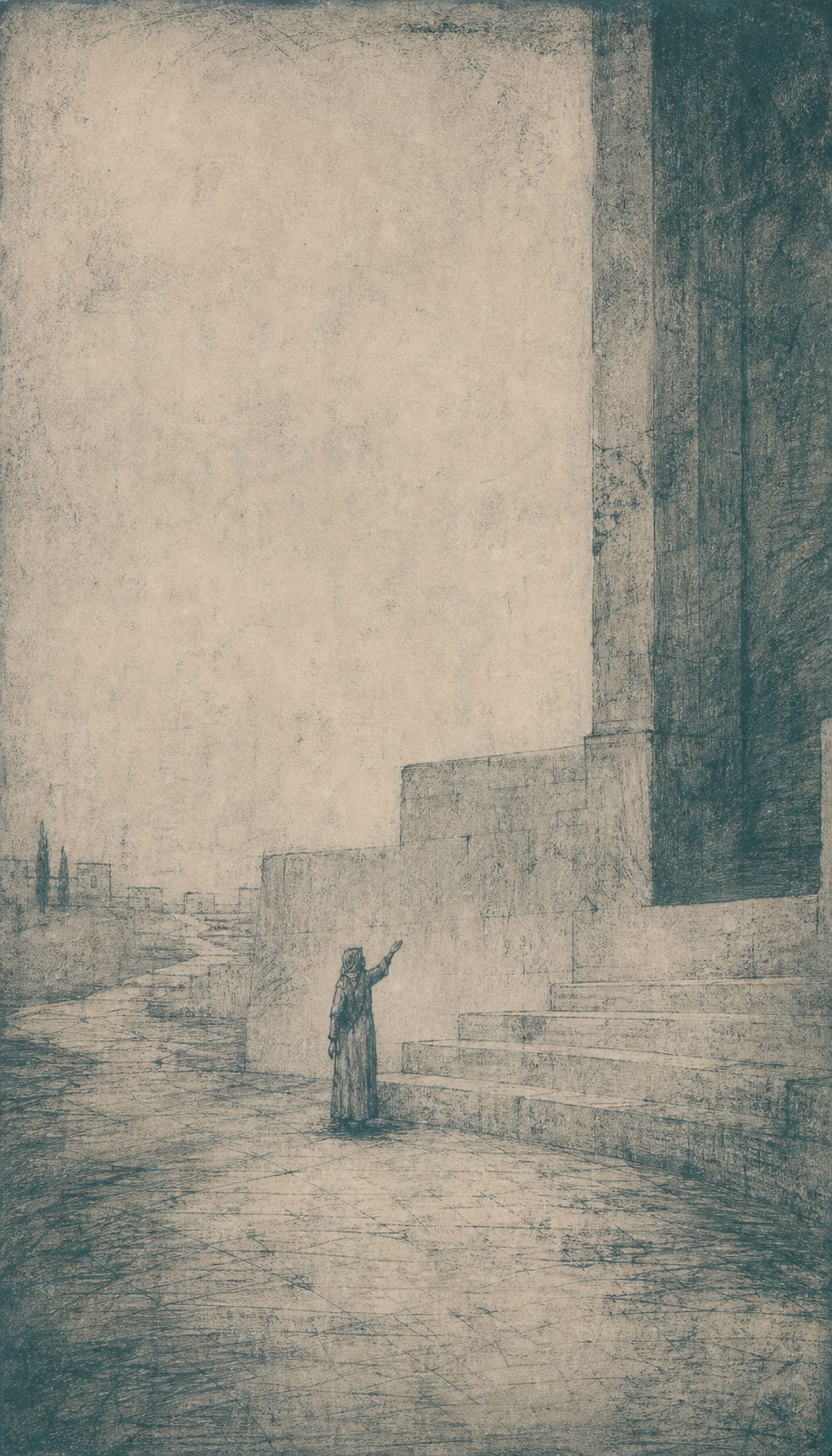
A tiny widow raises her voice before the massive steps and towering entrance of an ancient hall of judgment.

Publication 03 · Luke 17:20–18:8

Grant Me
Justice

A guide to prayer in the wait.

Begin reading

On the road with Jesus

What do we do while we wait for the world to be made right?

Jesus tells a story about a woman with no standing, no advocate, and no leverage—nothing to bring to the door but the truth of what has happened to her and her refusal to disappear.

Luke tells us why Jesus gives the story before it begins: so his disciples will always pray and not give up. But the parable does not stand alone. Chapter 18 opens with one small word: then.

Then Jesus told them this parable. Then—after speaking about the arrival of the Kingdom, the long delay, and the day when the Son of Man will be revealed. The widow’s cry belongs inside that waiting world.

“Grant me justice against my adversary.”

She is not asking for comfort. She is not asking for convenience. She is asking for what is right. Jesus places her prayer in the mouths of everyone who has ever wondered whether delay means God has forgotten the case.

It does not. The story is unfinished. The wait is not the verdict.

The WaitThe CryThe JusticeThe Practice
Women, men, and a child share an ordinary wedding feast beneath a simple canopy in first-century Judea.

01 · Life as Usual · Luke 17:20–37

The Wait

What does faith look like when the Kingdom has arrived but has not finished arriving?

Luke 17:20–37

The King is already standing in the room.

The Pharisees ask Jesus when the Kingdom of God will come. Their question carries an assumption: the Kingdom will be the kind of thing they can point toward. Here it is. There it is. A visible transfer of power.

Jesus answers that the Kingdom is already “in your midst.” The King is standing in front of them, and they do not recognize his reign because it has not arrived in the form they expected.

Then Jesus turns toward his disciples and names the tension they will have to inhabit. The Son of Man will be revealed in glory—but first he will suffer and be rejected. The crown comes after the cross, not around it.

Normal days do not announce the last one.

Jesus reaches into Israel’s memory: Noah and the flood; Lot and Sodom. He emphasizes the ordinariness of the days before judgment. People ate, drank, married, bought, sold, planted, and built. None of those things were the problem.

Life simply carried on as though tomorrow would always look like today. Then the flood came. Then the fire fell.

The wait may be long. The arrival will not be gradual.

The disciples ask where judgment will fall. Jesus answers with circling vultures—an image of judgment landing on people who assumed the day would never come. The warning is not meant to turn his disciples into date-setters. It is meant to keep them awake inside ordinary life.

The day is coming. It will not look the way we expect. And it has not come yet.

So what do we do with that unfinished space? Jesus does not give another timeline. He gives us a woman who keeps showing up.

Prayer Jesus, keep me awake to your Kingdom in the middle of ordinary days. Do not let the delay convince me that you are absent.
A tiny widow raises her voice before the massive steps and towering entrance of an ancient hall of judgment.

02 · The Widow · Luke 18:1–5

The Cry

What can someone with no leverage do when the system refuses to listen?

Luke 18:1–5

She has nothing but her refusal to disappear.

In a certain town, Jesus says, there is a judge who neither fears God nor cares what people think. He is accountable to no one. Across from him stands a widow whose social world has left her profoundly exposed.

She has no powerful name to invoke, no advocate to argue the case, and no leverage that might make the judge pay attention. Unlike the friend knocking at midnight in Luke 11, she cannot appeal to relationship, hospitality, or shared obligation.

She can only return to the door.

Would he see her? Would he remember her name after the third visit, the tenth, or the fiftieth? We do not know. We only know she repeats the same unedited sentence: “Grant me justice against my adversary.”

This is not merely a story about persistence. It is a story about justice. She refuses to stop naming the wrong for what it is.

A word beneath the story

ὑπωπιάζω

hypōpiazō · to strike beneath the eye

The judge worries that the widow will “wear him out.” Jesus uses language from the boxing ring: she is going to give him a black eye. Her persistence has become the one pressure an unaccountable man can feel.

The widow does not win by becoming powerful.

She does not outmaneuver the judge or learn to speak his language. She remains what she was: a person telling the truth about an injustice and returning until the truth can no longer be ignored.

Her prayer gives language to people whose calls are not returned, whose cases are indefinitely delayed, and whose pain is treated as an inconvenience. Jesus does not tell them to become less disruptive. He honors the cry.

Prayer God, receive the prayer I am tired of praying. Give me courage to name what is wrong and grace to keep returning to you.

03 · The Essential Correction

God is not the unjust judge.

God is a defender.

Luke 18:6–8

Jesus is arguing from lesser to greater.

If even an indifferent and unaccountable judge can be moved by persistence, how much more will God bring about justice for those who cry out to him day and night?

The judge responds because he is exhausted. The Father responds because justice belongs to his character. Scripture calls God a father to the fatherless and a defender of widows. He is not a kinder version of the judge. He is everything the judge refuses to be.

God does not need to be worn down before he cares.

Jesus speaks of God’s chosen ones in the plural. This is not only the private request of one person. It is the shared cry of a people longing for the Kingdom to finish arriving: How long? When will violence end? When will the exploited be restored? When will creation stop groaning?

“Quickly” does not sound like our experience.

Prayers continue for years. Some of the saints die still waiting for what they asked to see. Jesus does not deny the delay. The whole parable exists because the delay is real.

To understand “quickly,” we have to return to chapter 17. Lightning flashes. The flood arrives. Fire falls. The waiting is long, but when the decisive moment comes, God’s action is not tentative.

“Quickly” is not a promise about our calendar. It is a promise about how God finishes what he starts.

Freedom declared. Freedom enforced.

On January 1, 1863, the Emancipation Proclamation declared freedom for enslaved people in the rebelling states. But in Texas, that declaration went unenforced while enslavers continued to exploit the distance between what had been announced and what had arrived.

On June 19, 1865, federal authority reached Galveston and General Order No. 3 announced that those held as slaves were free. The announcement did not erase every act of resistance, violence, or exploitation overnight. But the delay could no longer be confused with the verdict.

Will he find faith on the earth?

The parable ends with a question, not a tidy resolution. Jesus names the risk of a long delay: not that God will stop being just, but that we will stop believing it long enough to keep asking.

The widow’s qualification is not that she understands the timeline. It is that she keeps returning. She does not decide the case. She refuses to abandon it.

The empty tomb is the verdict breaking into history.

Jesus himself stands before Pilate and the Sanhedrin with no earthly advocate, a verdict decided before the hearing begins. By oppression and judgment he is taken away. He cries out—and on the third day he is vindicated.

The resurrection does not mean every injustice has already been resolved. It means we know what God’s justice looks like when it arrives: the condemned one raised, the rejected one enthroned, and death itself stripped of the final word.

Prayer Just and faithful God, keep my hope rooted in the risen Jesus. Teach me to trust how you finish what you begin.

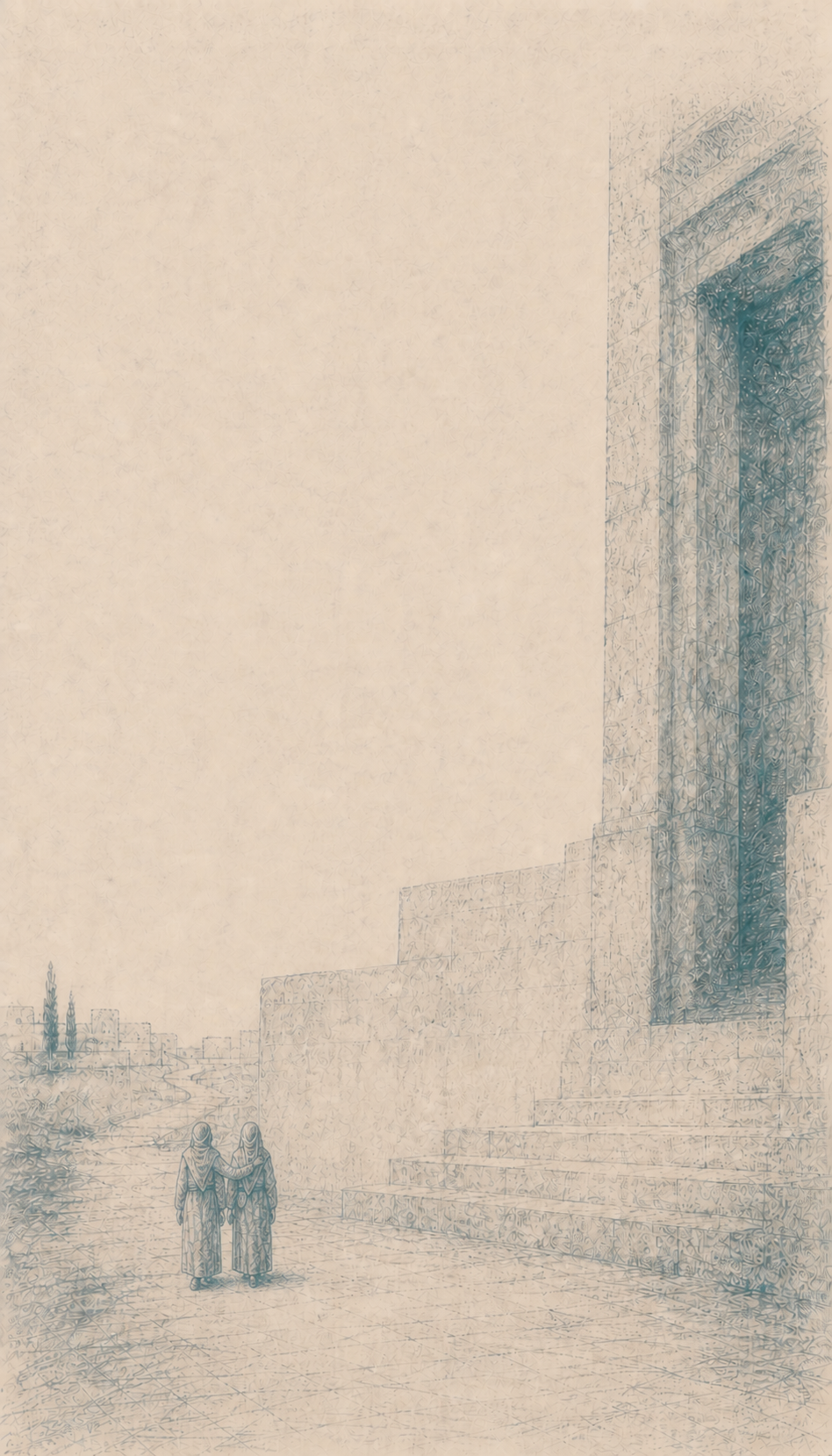
The widow and a companion walk away together from the immense hall, the companion's arm resting gently around her shoulders.

04 · The Response

The wait is not the verdict.

Cry out. Do not give up.

A way to keep faith alive

Name the wait. Keep crying out. Become an advocate.

The widow’s persistence is not cheerful. She is tired too. Jesus gives us permission to bring that exhaustion to God instead of hiding it beneath a performance of peace.

Think

The delay is not evidence that God has forgotten the case. The story is not finished.

Feel

It is okay to be tired of asking. Bring the anger, grief, and weariness honestly to God.

Do

Choose one injustice. Pray over it for seven days, then stand beside someone who currently has no advocate.

A simple way to begin.

01 · Name it

Say plainly what is wrong. Do not soften the truth to make it easier to carry.

02 · Ask

“Grant me justice.” Return to the prayer each day, even when nothing appears to move.

03 · Watch

Notice what God is doing in you, around you, and through the people who keep showing up.

04 · Advocate

Become the person who returns to the door alongside someone whose voice has been ignored.

Prayer keeps faith alive in the wait.

Prayer Father, I name the wrong before you. Keep me honest when I am angry, faithful when I am tired, and ready to stand beside those who have no advocate.

Luke 18:1

Always pray.
Do not give up.

God is nothing like the judge.

A blessing

May your prayer become less afraid of the wait.

More honest. More persistent. More convinced that God is just.

May you keep asking—and become an advocate for someone who cannot ask alone.

Jesus turns an already upside-down world right side up.