RSU
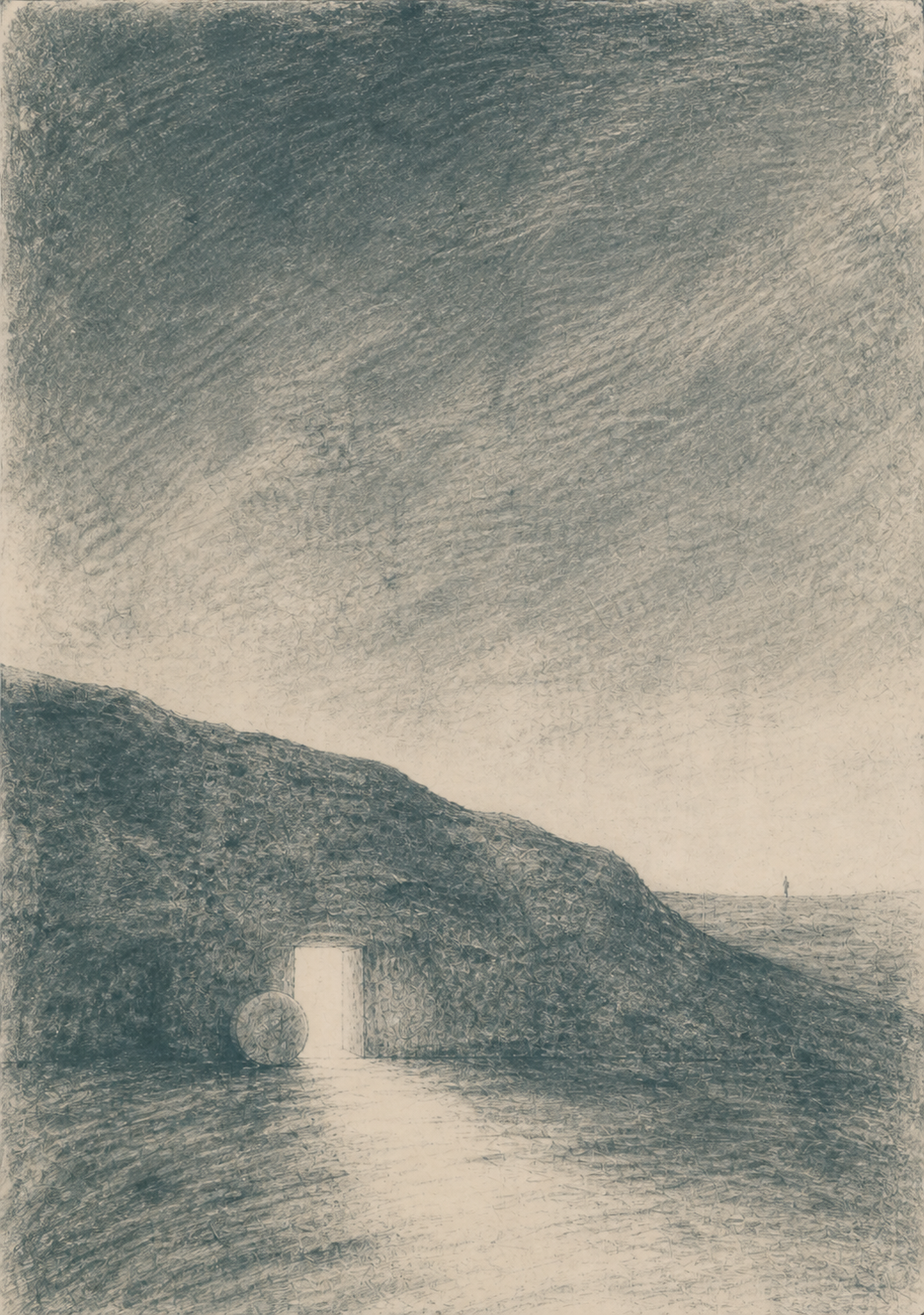
Light pours from an empty tomb into the early morning landscape.

A Right Side Up Studio Publication · John 20–21

Living
Hope

Three encounters with the risen Jesus.

Begin reading

An invitation

We cannot stop telling resurrection stories.

Every generation tells them in a hundred different forms. Buried in the human imagination—in every culture and every century—is a haunting intuition: death cannot be the end. The darkest moment cannot be the final one.

We keep returning to stories in which what looked finished begins again, what was lost is restored, and love proves stronger than the grave. We keep telling resurrection stories because we were made for one.

But the resurrection of Jesus is not an escape from the real world. It arrives inside one: political chaos, economic pressure, disputed truth, private grief, wounded belief, and remembered failure.

The world did not become stable before Jesus rose. He rose in the middle of it.

And then Jesus meets people there—not as abstractions, but by name, by touch, and beside a small fire. These are not three arguments for hope. They are three encounters with the living Christ.

The WorldThe GardenThe RoomThe Shore

Political chaos.
Economic wreckage.
A culture arguing
over what is true.

And God was already at work.

01 · The World

The World

Can I trust God is at work when the world does not feel stable?

The world behind John 20–21

The Senate had him killed by nightfall.

In AD 31, a political assassination shook the Roman Empire. Tiberius Caesar had grown disillusioned with ruling but kept the privileges of power. He retreated to Capri and handed the empire’s daily affairs to a man named Sejanus—until Tiberius decided Sejanus had collected too much loyalty.

Sejanus arrived at the Senate expecting to be elevated. Instead, charges were read aloud before the chamber. He was executed before the day was over.

Nobody knew whom to trust. The official story and the real story were not always the same thing.

Was Sejanus guilty? Was Tiberius the real danger? Historians still argue. The people living through it had no way to know what was actually true. The political class fractured. Riots broke out. Purges followed.

Then the debts came due.

In the very year of Jesus’s death and resurrection, an old lending law—ignored for years—was suddenly enforced. Debts were called in. Land was lost. Freedom was lost. While powerful people debated the scale of the problem, ordinary families absorbed it.

Underneath it all, pressure was building at the empire’s edges. Judea was occupied, volatile, and waiting generations for liberation. Pontius Pilate knew the wrong arrest could ignite the whole region.

This is the world the resurrection is born into. Not so different from ours.

This is not a detour into history. It is an introduction to the neighborhood: political chaos, economic wreckage, a culture that cannot agree on what is true, and a world that feels as though it is coming apart at the seams.

Not in a palace. In a garden.

While that world was unraveling, something was quietly being put back together—not in a palace, not in the Senate, not in any room where the chaos was being managed. In a garden. In a tomb.

The first person to encounter it was not a general, senator, or emperor. It was a grieving woman named Mary.

Prayer God who moved while empires argued, move in my chaos too. You have never needed a stable world in order to be faithful.
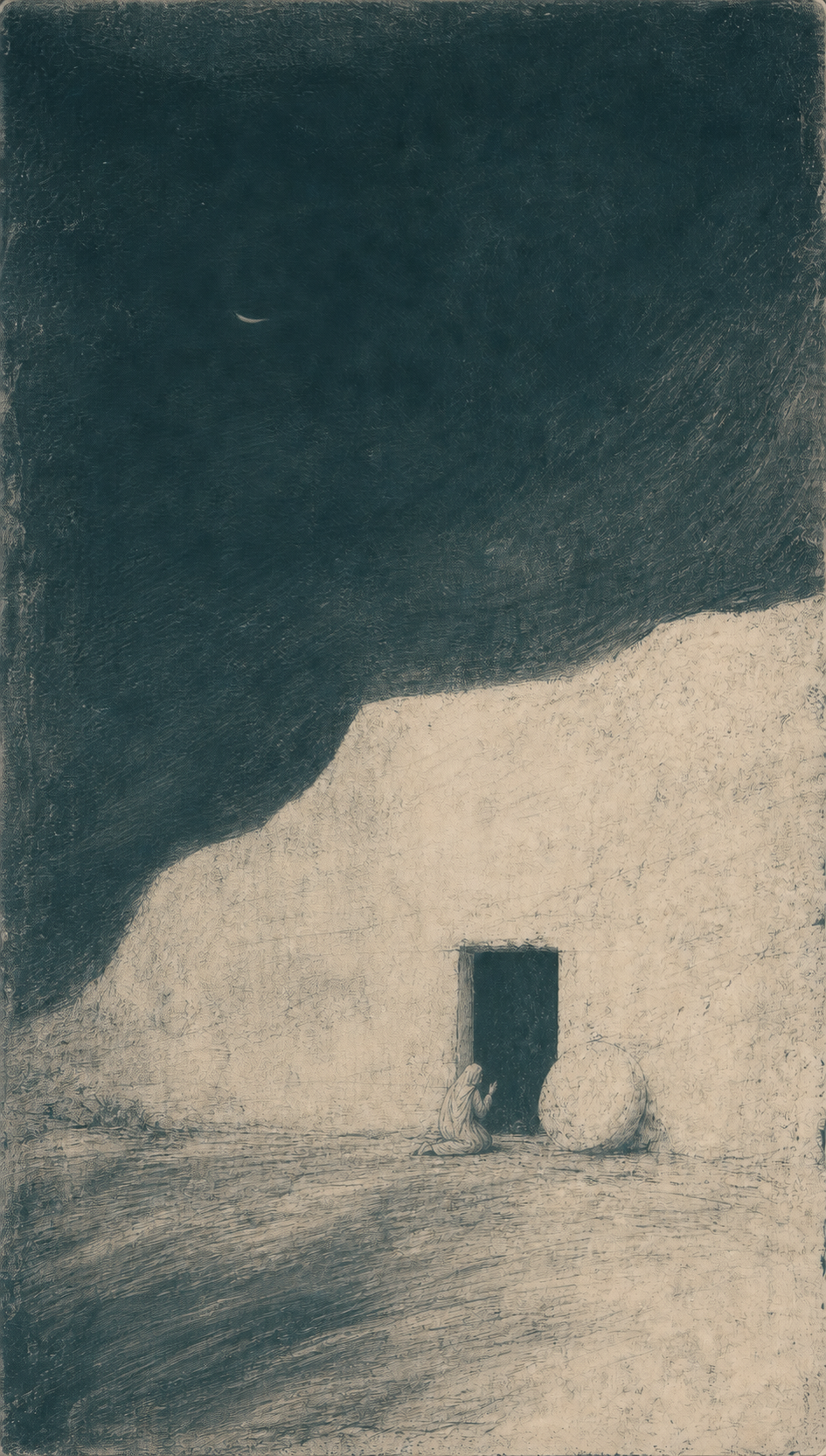
Mary kneels before the open tomb beneath a vast dark sky.

02 · The Garden

Mary

Can Jesus meet me in my grief?

John 20:1–18

It starts as a funeral.

Early on the first day of the week, while it was still dark, Mary Magdalene went to the tomb. The Easter story does not start as a triumph. It begins in grief.

She cannot wait for sunrise. Grief does not wait. The Sabbath came fast after Jesus died—no time for the spices, the oils, or the full mourning rites. Mary comes back the first moment she possibly can. She has come to finish a funeral.

This loss is larger than losing someone she loved. Jesus had delivered her from a darkness no human hands could reach. She had reordered her entire life around the conviction that God’s future had arrived in him. His death is the loss of hope on a crushing scale.

The stone is already moved.

Mary does not assume resurrection. Her mind goes to the next worst possibility: someone has taken the body. She runs for Peter and John. They look inside, find the linen cloths, and leave bewildered.

Mary stays. She is left outside the tomb with the questions they cannot answer and the grief they cannot carry for her.

The story begins again in a garden.

The Bible begins with a garden, where God breathes life into dust and rests on the seventh day. Now, on the first day of a new week, in another garden, creation begins again. Mary is standing at the hinge of history, but she cannot see it yet.

Then he speaks her name.

She turns and sees a man she takes for the gardener. “Woman, why are you crying? Who is it you are looking for?” She asks him where the body has been taken.

Jesus said to her, “Mary.”

Our name is the sweetest sound to our own ears. She can see Jesus and not recognize him until he speaks hers. Hope is not wishful thinking here. Hope has flesh and blood and is standing in front of her.

Jesus does not shame Mary for failing to understand. He meets her inside the grief and turns her toward a future she could not have imagined. Then he gives her something to do: go, and tell them.

As early as the third century, the church called Mary the “Apostle to the Apostles”—the one sent to announce the resurrection to those who would carry the news into the world. A woman once discarded becomes the first witness and the first messenger.

Prayer Meet me in the dark, the way you met Mary. Speak my name before I have the strength to look for you.

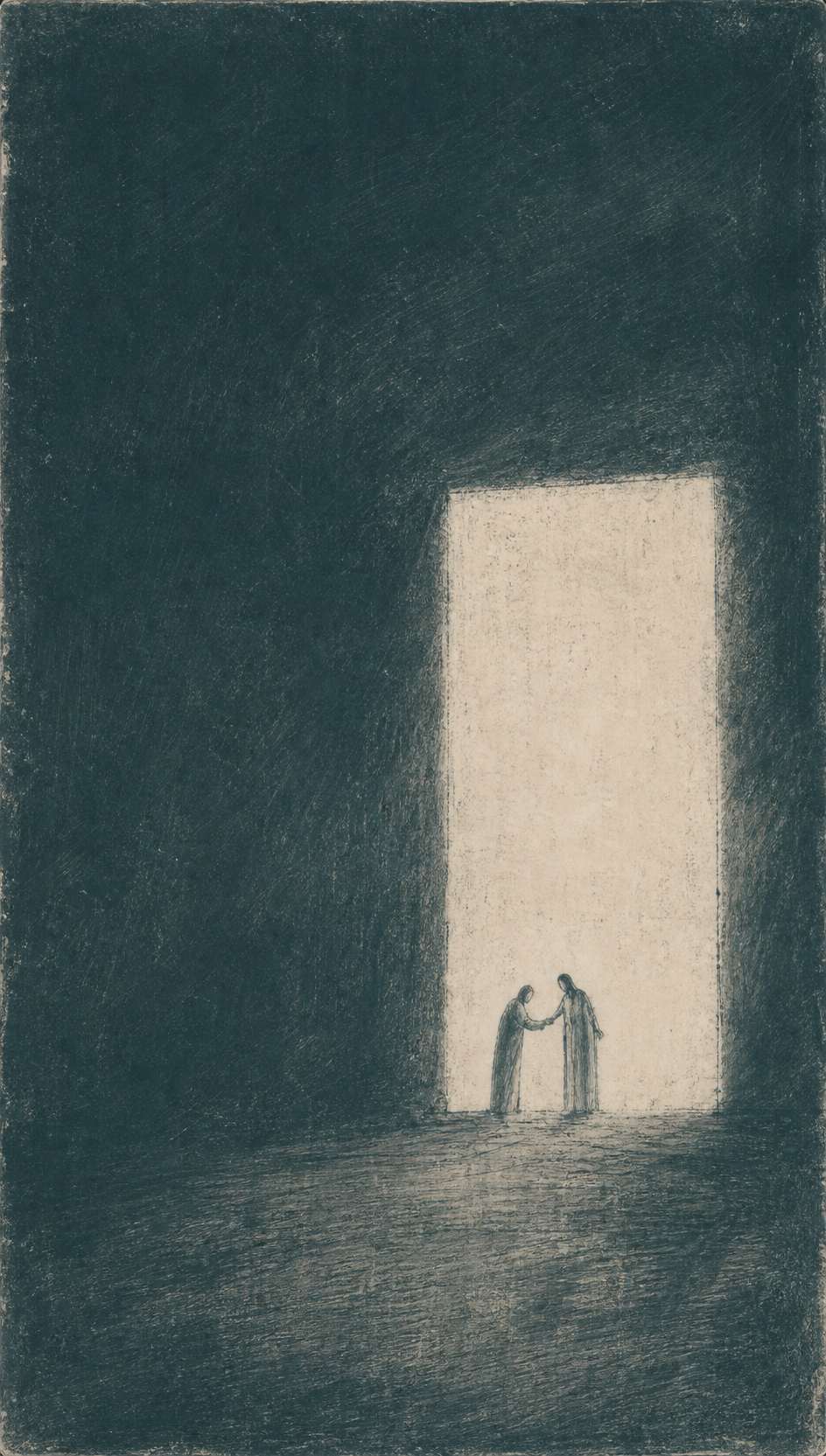
Thomas reaches toward Jesus in a tall doorway of light.

03 · The Room

Thomas

What do I do with doubt that is really disappointment?

John 20:24–29

He walked through a locked door. Twice.

The disciples are together that evening with the doors locked because they are afraid. Jesus comes and stands among them: “Peace be with you.” John is not trying to make this sound ordinary. People do not simply appear in locked rooms.

But Thomas misses it. When the others tell him they have seen the Lord, he answers, “Unless I see the nail marks in his hands and put my hand into his side, I will not believe.”

His doubt was not a lack of evidence.

Thomas had watched Jesus feed a crowd. He had seen dead men walk out of tombs. He had bet his life on who Jesus said he was. But the Messiah was not supposed to die—not in the future Thomas had imagined.

Everything he had staked his life on seemed sealed in a tomb. And while everyone around him kept saying Jesus was alive, Thomas had somehow missed the encounter. This was disappointment. Hurt. A heart going numb to protect itself.

Even without believing, Thomas stayed close to the people who did.

A week later, the doors are locked again. Jesus comes again. He does not begin with “You should have believed sooner.” He begins with peace.

The wounds became the doorway.

Jesus invites Thomas to touch the places where violence had marked him. Thomas’s wounds are hidden. Jesus’s are visible—and they become the doorway through which Thomas can believe that death has truly been defeated.

“My Lord and my God.”

What is true of Jesus will one day be true of us and of everything broken. Resurrection does not pretend the wounds never happened. It gathers them into a body death can no longer keep.

Our doubts rarely need a louder argument. Sometimes they need the presence of someone who has been through death and come out the other side.

Prayer Meet me with peace, not correction. Let your wounds become the doorway to what I have stopped believing could be healed.

Jesus and Peter sit beside a small fire under a vast teal sky.

04 · The Shore

Peter

Can failure become calling?

John 21:1–19

We remember where we last saw him.

John’s Gospel seems ready to end after Thomas. Then one more chapter begins, centered on Peter—the disciple who promised he would die before denying Jesus and then could not hold himself together beside a charcoal fire.

The rooster crowed. Peter went out and wept. It was the worst moment of his life.

Now he is back in the boat.

Peter returns to the Sea of Galilee, to fishing, and almost to his old name: Simon, not Peter, “the Rock.” Failure has a way of making us retreat to the person we were before we were called.

Then a man on the shore tells them to cast the net on the other side. The net fills. John recognizes the pattern: “It is the Lord.” Peter does not wait for the boat. He throws himself into the water and swims.

When they landed, they saw a fire of burning coals, with fish on it, and some bread.

There are only two charcoal fires in John’s Gospel. One burns beside Peter’s denial. The other burns beside his restoration. Jesus has returned Peter to the place of failure—but he does not return him there to humiliate him.

“Do you love me?”

Three times Jesus asks. Three times Peter answers. The bravado is gone. Peter no longer promises what he will accomplish. He can only offer what is true: “Lord, you know me. You know that I love you.”

And Jesus says that will be enough.

For Peter’s three denials, he receives not three corrections, but three commissions: feed my lambs, care for my sheep, feed my sheep. Jesus does not merely forgive him. He entrusts people to him.

Failure is not the end of Peter’s calling. It becomes the place where calling begins again.

Then Jesus speaks the words Peter first heard beside these same waters: “Follow me.” I called you away from these boats once before. I renamed you—not for who you were, but for who I would make you. I knew you would fail. I have forgiven you. And I am still calling you.

Prayer Call me again. I do not have more than “this is all I’ve got.” Meet me there, the way you met Peter.

The big idea

The resurrection does not erase grief, doubt, or failure.

It gives them a future.

Living Hope

Grief, doubt, and failure become holy ground.

Mary’s grief is not dismissed. Thomas’s doubt is not ridiculed. Peter’s failure is not hidden. Jesus meets each of them in the place where their future seemed to have ended.

He does not only comfort Mary. He sends her. He does not only answer Thomas. He gives him a confession that will carry him across the world. He does not only forgive Peter. He entrusts the church to his care.

Jesus does not merely return what was lost. He calls each of them forward.

What happened next?

Mary became known as the Apostle to the Apostles, carrying the first announcement that Jesus was alive. Thomas carried the good news east, remembered by ancient Christian communities as far away as India. Peter became a shepherd to the early church and gave his life for the hope he once denied knowing.

The garden, the room, and the shore were not the end of their stories. They were the places their stories began again.

Firstfruits.

The New Testament calls Jesus the firstfruits of those who have died. His resurrection is not a private miracle or an isolated exception. It is the first arrival of what God intends to do with all creation.

“Death has been swallowed up in victory. Where, O death, is your victory? Where, O death, is your sting?”

What is true of Jesus will one day be true of everything held in him. Every grave emptied. Every wound healed without being forgotten. Every good thing restored. Every upside-down part of the world turned right side up.

The Easter story invites you in.

Not as a spectator. As someone Jesus is looking for—in your grief, your doubt, and your failure—the same way he found Mary in a garden, Thomas in a locked room, and Peter beside a fire on the shore.

Think

Where have I mistaken darkness for the end of the story?

Feel

What grief, disappointment, or failure can I allow Jesus to meet?

Do

What would it look like to hear my name, reach toward his wounds, or follow him again?

Prayer God and Father of our Lord Jesus Christ, you have given us new birth into a living hope through the resurrection of Jesus from the dead. Meet us on our holy ground. Speak our names. Meet our wounds. Call us again.

1 Peter 1:3

There is good news. Jesus is alive.

And everything he promised is already underway.

A blessing

May your name be spoken.

May your wounds find their doorway.

May you hear, again, “Follow me.”

The Kingdom turns an already upside-down world right side up.